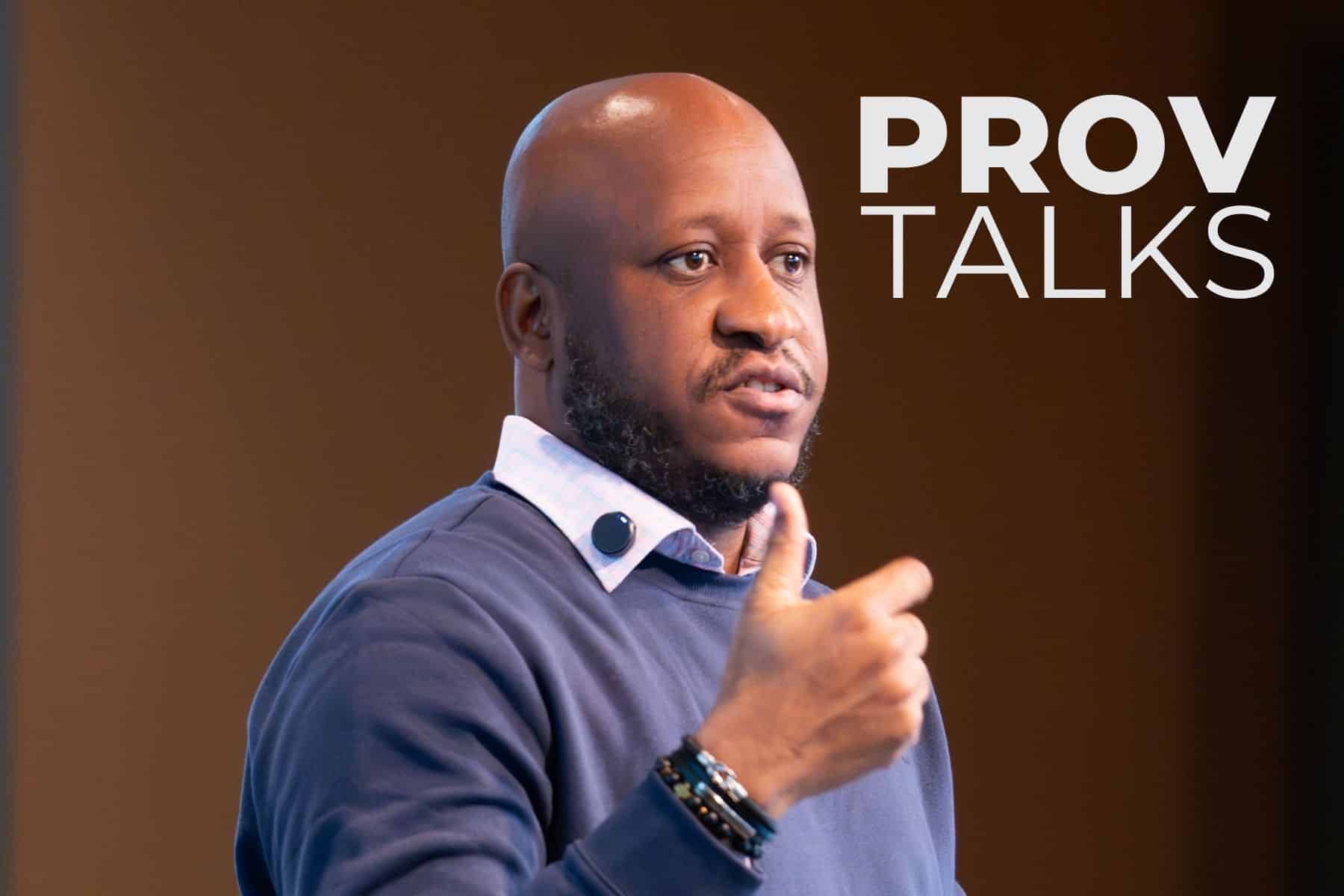
PROV Talks took place this year during the afternoon of Monday, March 23rd, featuring eight short, thought-provoking presentations on various topics by some of Providence’s faculty, staff, and students. Find our 2026 presenters, a short description of each talk, and their corresponding videos below.
GROUP ONE
Strategic Alliance: Lessons in COVID-19 Vaccine Development
Kehinde Victor Soyemi, MD
Partnership through what’s called “strategic alliance” is often an approach that is employed in business expansion, but can also be seen in the development of innovative products within the pharmaceutical industry. During the COVID-19 pandemic, this was seen most recently in the need to quickly develop vaccines through such alliances, and the success of such unprecedented collaboration has significant implications for future vaccine development.
Grieving? Don’t Mention It!
Luann Hiebert, PhD
What do you say when someone has lost a mother, a spouse, a daughter, a brother, an infant, or a best friend? What do you say when someone says they have cancer, or some debilitating disease, become blind, or endured abuse? Most people (if not all) carry a silent yet persistent pain or sorrow. If grief is so common, why do we shy away from talking about loss, dying, or the death of a loved one? Grief matters. How do we deal with grief? In what ways might we make room to talk about loss and grief – either our own experiences with grief or for others who are grieving? In this PROV Talk, Hiebert engages with these questions through reflections and poems she has written about her own journey with grief.
Jesus Redeems People (And Sometimes He Heals Them)
Daniel Rempel, PhD
Bodily healing is a central component of most Christian belief systems. Rooted in readings of the Gospels, Christians pray and hope for bodily healing in the face of illness, disease, and the breakdown of the body. However, problems occur when people don’t receive healing. Is God not listening? Does the prayer not have enough faith? Upon closer look, however, Jesus doesn’t actually heal everyone he meets. Noting this tension, this talk revisits Jesus’ healings and argues that healing is primarily about redemption – and sometimes our bodies are healed too.
An Inkling Plays with Acts 1:16-17: Charles Williams and the Lunatic Judas Iscariot
Michael Gilmour, PhD
The English literary circle known as the Inklings included such luminaries as J. R. R. Tolkien, C. S. Lewis, and Owen Barfield. A less familiar member of that esteemed circle is the poet, novelist, literary critic, and editor Charles Williams. This presentation considers Williams’ creative engagement with Christian themes as found in his 1945 play The House of the Octopus, in which we find the writer drawing extensively from the book of Acts and reimagining Judas Iscariot.
GROUP TWO
“The Fustent”: Collision of Time in Isaiah 26
Sarah Barkman
In the middle of the book of Isaiah is an often-overlooked song stuck in a section devoted to world-wide eschatological catastrophe. The introduction to the song tells us, “On that day this song will be sung in the land of Judah” (Isaiah 26:1). The lyrics that follow intertwine victory and lament, speaking of the future in terms of the past. What purpose does the prophet have for interjecting his message for the present with lyrics to a song that no one is yet singing? What implication is there for sharing this future song now?
A Theoretical Examination of Contributing Factors to the Proliferation of Political Vigilantism: Evidence from Ghana
Daniel Owusu Nkrumah, PhD
Political vigilantism is extralegal or illegal political action by non-state actors, often involving violence. This undermines the rule of law and democracy globally and poses a major obstacle to Ghana’s political development in the Fourth Republic. Using structuration, institutional failure, and social learning theories, this qualitative study examines factors driving its prevalence. Findings show that failures of key state institutions and political interference have enabled vigilantism, sustained by unemployment, poverty, illiteracy, and politicians’ pursuit of power. The study recommends institutional independence, particularly for electoral and criminal justice bodies, to curb vigilantism and strengthen Ghanaian democracy.
Nature-Deficit Disorder in the Newcomer Classroom
Jeannine Brandt
Newcomers to Canada experience physical, mental, and emotional burnout as they navigate culture shock, artificial learning environments, digital literacy, and high stakes assessments. Research shows that current education systems are divorcing us from personal and collective vitality. In this presentation, Brandt draws on her own research with English language learners and education literature to integrate four practical nature-based competencies into educational spaces to create sustainable and restorative learning environments that enhance concentration and engagement, wellness, and environmental healing.
Facing the Heat of Fahrenheit 451
Christopher Lortie, PhD
Dystopian literature can both reveal the fears of past generations, but also closely resonate with contemporary concerns – so much so that history is experienced to repeat itself. Ray Bradbury’s 1953 novel Fahrenheit 451 is one such work, which follows the story of a “firefighter” named Guy Montag who is tasked not with putting out fires, but burning books. The implications for us today are many – especially in an academic setting – including the importance of honest dialogue, questioning authority, and exploring diverse and complex ideas.